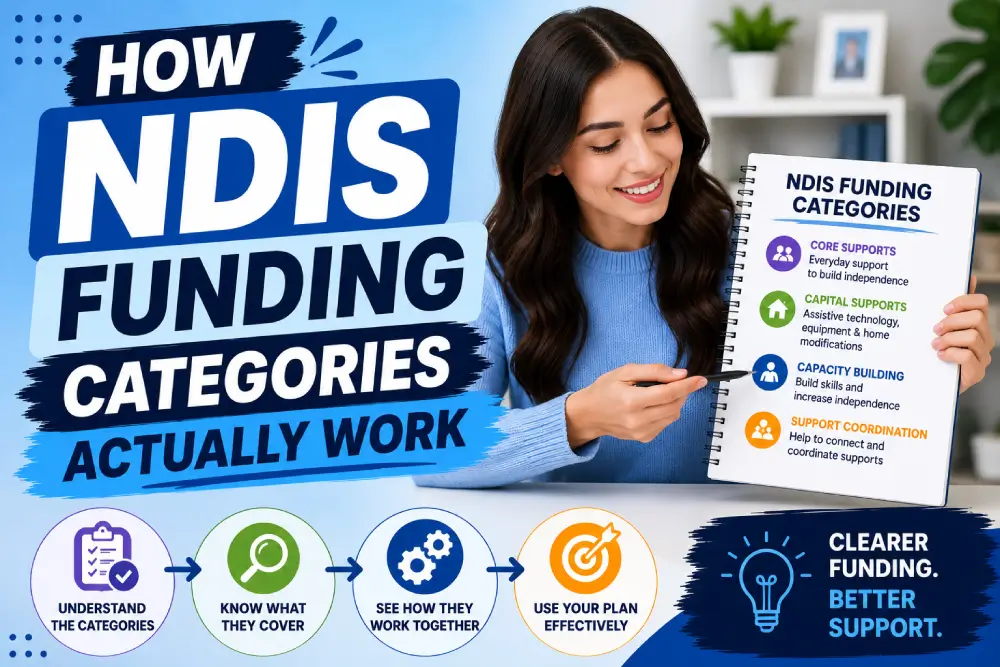
The NDIS plan splits your funding into categories and sub-categories that can confuse people for years. Here’s the practical breakdown of what each category covers and how it affects what you can spend money on.
There are three top-level funding categories: Core Supports, Capital Supports, and Capacity Building Supports.
Core Supports: The Day to Day Budget
Core Supports cover the day-to-day stuff. Personal care, domestic assistance, community participation, transport, and consumables. This is usually the biggest part of most plans. Within Core Supports, there are sub-categories. Assistance with Daily Life covers personal care and domestic. Transport is a flat funding allocation. Consumables covers things like continence aids and low cost assistive technology. Assistance with Social, Economic and Community Participation covers community access. The good news is that within Core Supports, you have flexibility. You can usually move money between Daily Life and Community Participation as you need to. The exception is Transport funding, which is usually paid as a fortnightly allowance and is intended specifically for transport costs.
Capital Supports: One-Off Items and Equipment
Capital Supports cover one-off items. Assistive technology (wheelchairs, hoists, communication devices), home modifications (ramps, bathroom modifications), and specialist disability accommodation. This funding is usually quite specific. If your plan has $5000 for assistive technology, you can’t spend it on personal care. Capital Supports often require quotes and assessments before the funding can be released. You usually need an OT report or similar to justify the specific equipment.
Capacity Building Supports: Skill Development
Capacity Building Supports are for skill development and improving your independence. This category has lots of sub-categories including Improved Daily Living (allied health like OT and physio), Improved Living Arrangements (help finding housing), Increased Social and Community Participation (group programs, mentoring, learning new skills), Finding and Keeping a Job (employment support), Improved Health and Wellbeing (exercise physiology, dietetics), Improved Learning (study support), Improved Life Choices (plan management is funded under here), and Support Coordination. Each sub-category is its own pot of money. You can’t move funding between them. So if you have $2000 for Improved Daily Living and $3000 for Improved Health and Wellbeing, the OT money and the exercise physiology money stay separate.
Flexibility Within Categories (and Where There Isn’t Any)
The flexibility within categories is the part that confuses people. Within Core Supports, money is fairly flexible. Across categories, it’s not. So if your plan has $20,000 for Daily Living and $3000 for Capacity Building, you can’t use the Daily Living money on physiotherapy. And you can’t use Capacity Building Improved Daily Living funding on personal care, even though both relate to “daily living.”
Stated Supports: When Funding Is Locked to a Specific Use
Some funding has to be used on specific things. Transport funding under Core Supports is allocated as a transport allowance and is intended for travel costs. Some Capacity Building items are stated supports, meaning the plan specifies how the money is to be used. If your plan says “Speech therapy: $2500 stated,” that money has to go to speech therapy. You can’t use it on a different therapy.
Who You Can Pay Under Each Management Type
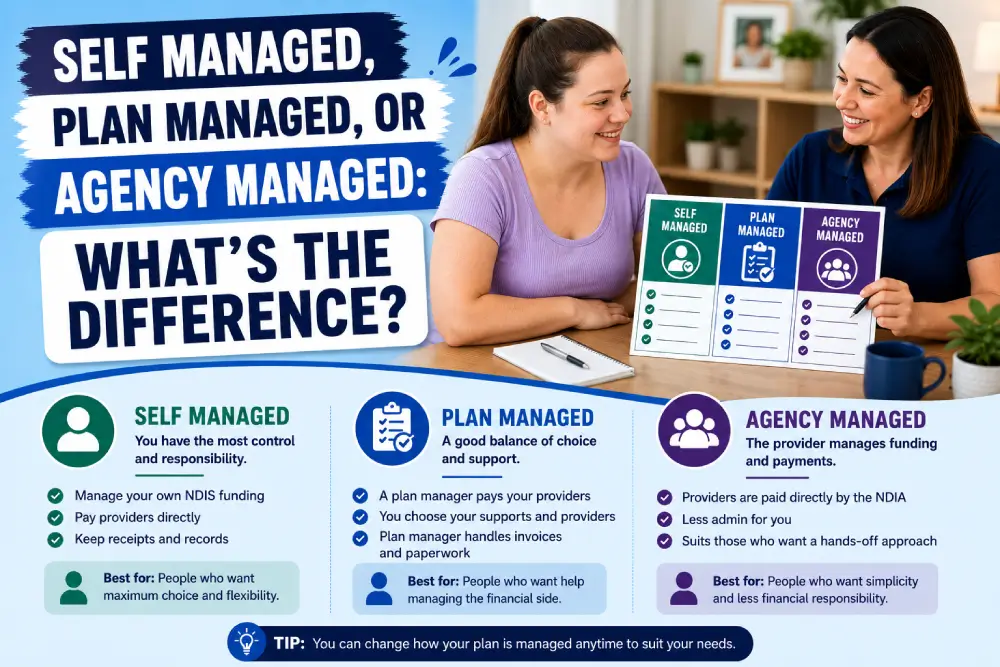
Plan managed and agency managed plans have different rules about who can be paid from each category. Agency managed plans can only pay registered providers. Plan managed and self managed plans can pay both registered and unregistered providers, but unregistered providers can’t deliver supports that have to come from a registered provider (like Specialist Behaviour Support).
When you’re looking at your plan, the funding categories tell you what supports you can buy. If something you need isn’t in the right category, you can’t pay for it from your plan, no matter how reasonable the request seems. This is one of the reasons getting your initial plan right matters so much.
How This Plays Out in Real Plans
Some examples of how this plays out in practice. A participant has $30,000 in Core Supports Daily Living and $4000 in Capacity Building Improved Daily Living. They use the Core Supports for daily personal care and household help. They use the Capacity Building money for fortnightly OT sessions to work on independence skills. The two budgets are spent separately and serve different purposes.
Another participant has $15,000 in Core Supports including $2000 specifically for transport, $5000 in Capacity Building Increased Social and Community Participation for a group program, and $3000 in Capital Supports for assistive technology. The $2000 transport funding pays for trips to medical appointments. The $5000 group program funding is locked into the program. The $3000 capital is used for a specific piece of equipment after an OT report.
Getting Help Understanding Your Plan
If you’re confused about what your plan covers, ask your plan manager or support coordinator. They look at plans every day and can usually give you a clear answer about what you can and can’t spend on. We can also help our participants understand which parts of their plan are relevant to the services we provide, though we always recommend involving a plan manager or coordinator for the bigger picture.
Frequently Asked Questions
Can I move NDIS funding between categories?
No, not across the three top-level categories. Within Core Supports there’s some flexibility (e.g. between Daily Living and Community Participation), but Capital and Capacity Building funding is locked to its specific purpose.
What’s the difference between Core Supports and Capacity Building?
Core Supports fund day-to-day assistance like personal care and transport. Capacity Building funds skill development and independence, such as allied health therapy or employment support.
What are stated supports in an NDIS plan?
Stated supports are funding items where the plan specifies exactly what the money must be used for, such as “$2500 stated for speech therapy,” which can’t be redirected to another service.
Can I use Capacity Building funding for personal care?
No. Capacity Building Improved Daily Living funds therapy and skill-building, not personal care, even though both sound related to “daily living.”
Who can explain my NDIS funding categories to me?
Your plan manager or support coordinator reviews plans regularly and can explain what each category covers and what you can spend it on.