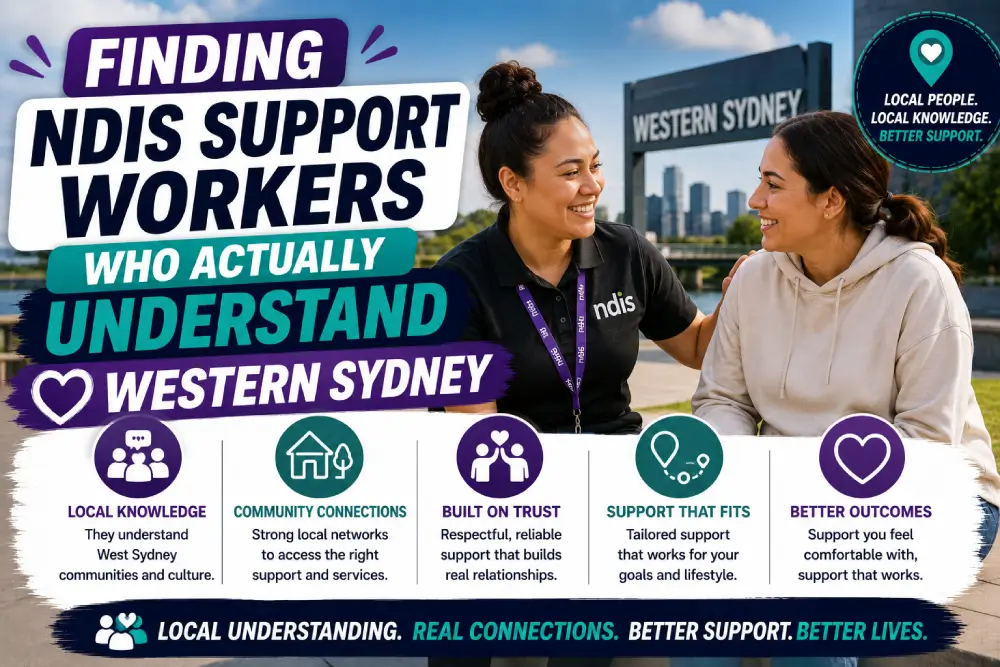
There’s a difference between a support worker who shows up in Mount Druitt and one who knows Mount Druitt. The first does the job on paper. The second knows that the bus from the station to Lethbridge Park stops at certain times, that the GP at the clinic on Luxford Road bulk bills, and that Tregear Reserve is quieter on weekday mornings if your participant doesn’t cope well with crowds. That kind of knowledge isn’t taught in a Cert III. It comes from actually living and working in the area.
Why We Hire Local, Not Just Nearby
When we hire support workers at Lucky Support Solutions, we look for people who live in Western Sydney or have spent significant time there. Not because there’s anything wrong with someone driving in from the Inner West, but because participants get better service from someone who can answer practical questions without checking Google. If a participant says they want to go to Mount Druitt Hub, a local worker knows the parking situation, the accessible entrances, and which shops are good for a quick visit.
Cultural Fit Matters as Much as Local Knowledge
Western Sydney has a specific character. It’s culturally diverse, mostly working-class, and full of families with multiple generations living in close quarters. A support worker who’s worked in inner Sydney aged care might be brilliant but not used to working with extended family members in the room, or with participants whose first language isn’t English, or with families where decisions get made collectively rather than one-on-one. None of those things are problems. They’re just things you adjust to. Local workers have already adjusted.
Travel Time Eats Into Your Support Time
If your support worker lives 45 minutes away, that’s their commute eating into your support time, especially if they’re rushing to get to the next participant. A worker based in Blacktown or Mount Druitt can be at your door in 10 to 15 minutes, which makes a real difference for participants who need flexibility.
Local Workers Tend to Stay Longer
The disability support sector has high turnover, partly because of pay and partly because workers burn out. Workers who live close to their participants have shorter commutes, more chances to do shorter shifts, and stronger ties to the local community. They tend to stick around, which matters because every time a worker leaves, the participant has to start over with someone new.
What to Ask a Provider Before Signing Up
Ask where their support workers are based. Don’t just ask if they cover your area — ask if their workers actually live there. Ask how they match participants with workers: a good provider thinks about personality fit, language, cultural background where relevant, and gender preferences, and gives you the chance to meet the worker before locking anything in.
Warning Signs to Watch For
Providers who can’t tell you where their workers are based, providers who change your worker frequently with little notice, and providers who push you to accept whoever is available rather than someone you actually click with. These are signs that the focus is on filling shifts rather than building relationships.
In our experience, the participants who get the most out of NDIS supports are the ones who have a stable, consistent worker they trust — one who knows their routine, their preferences, their family, and the local area. Western Sydney isn’t just a service area for us. It’s where our team lives.
Frequently Asked Questions
Why does it matter if my NDIS support worker lives locally?
Local workers know practical details like transport, accessible venues, and local services without having to look them up, and they can typically reach you faster.
Do local support workers stay in the role longer?
Often yes. Shorter commutes and stronger community ties tend to mean lower turnover, which supports the consistency that good NDIS support depends on.
What should I ask a provider about where their workers are based?
Ask specifically whether their workers actually live in your area, not just whether the provider “covers” it, and how quickly they can typically reach you.
How do good providers match participants with workers?
They consider personality fit, language, cultural background, and gender preferences, and let you meet the worker before committing.
What are warning signs of a provider that isn’t really local?
An inability to say where workers are based, frequent unexplained worker changes, and pressure to accept whoever is available rather than a good match.