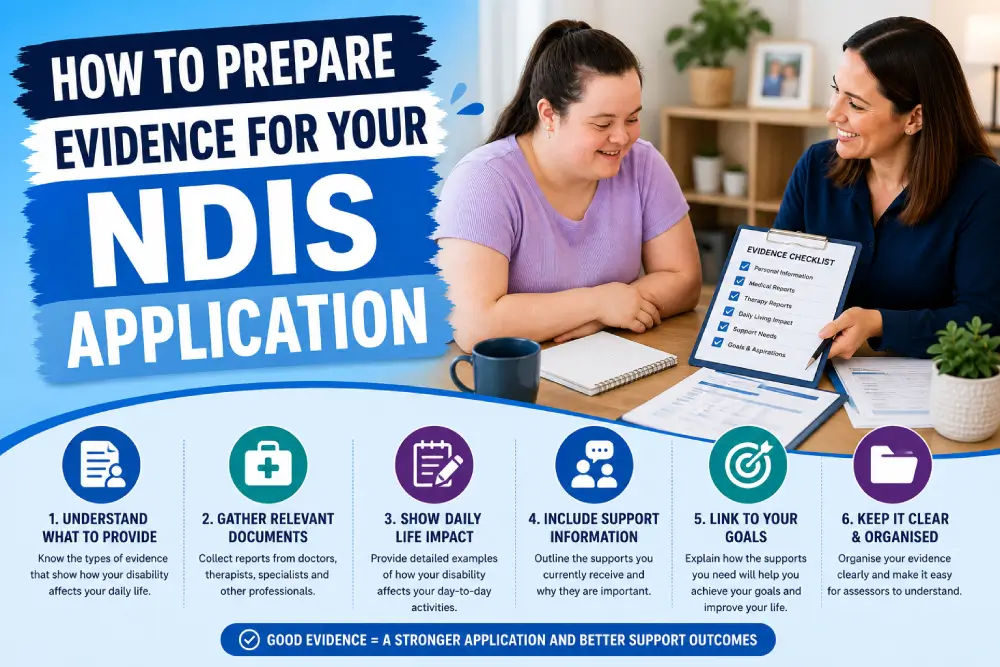
Getting NDIS funding starts with proving you meet the eligibility criteria. The NDIA needs evidence that your disability is permanent and significantly affects your daily life. What counts as evidence and how much you need is one of the most common things our participants have asked us about over the years.
What Counts as Evidence for Your NDIS Application
The basic requirement is a disability that’s likely to be permanent. The NDIA wants documentation from the right kind of professional. For most physical disabilities, that’s a specialist (like a neurologist or rheumatologist), not just a GP. For intellectual disability, you’ll need a psychologist’s assessment. For autism, a paediatrician, psychiatrist, or psychologist diagnosis. A GP letter on its own is rarely enough except for confirming things like the date of onset of certain conditions.
Which NDIS Forms You Need
The forms you need depend on your situation. The standard one is the Access Request Form. It asks about your disability, how it affects you, and what supports you currently use. You fill in the parts about you and your daily life. Your treating professional fills in the medical sections. The Access Request Form is downloadable from the NDIS website, or your LAC can give you a copy.
Working With Your Doctor or Specialist
When you ask a doctor or specialist to fill in the forms, give them time. Two weeks minimum. Some specialists charge for filling in NDIS paperwork, often around $50 to $200 depending on complexity. Ask about this when you book the appointment so there are no surprises. If cost is an issue, your GP may be able to help with the parts they can validly comment on, even if you also need specialist input.
Why the NDIA Needs Functional Impact, Not Just a Diagnosis
What the NDIA looks for is functional impact, not just diagnosis. A diagnosis on its own doesn’t get you funded. They want to see how the disability actually affects what you can do day to day. So your specialist needs to write specifically about what tasks you can’t manage, how often you need help, and what kind of help you need. “Patient has multiple sclerosis” is not enough. “Patient has multiple sclerosis with significant fatigue limiting standing to less than 15 minutes, requires assistance with showering and meal preparation, cannot drive, and has cognitive symptoms affecting concentration” is the level of detail required.
If your specialist isn’t familiar with NDIS forms, give them a copy of the NDIA’s evidence guidelines. These are on the NDIS website. Some specialists have done plenty of these forms and know what’s needed. Others haven’t and need pointing in the right direction. Don’t be afraid to ask your specialist whether they’ve done NDIS applications before. If they haven’t, you might want to seek out one who has.
Evidence From Allied Health Professionals
Other useful evidence includes letters from allied health professionals. Occupational therapists, physiotherapists, psychologists, speech therapists. These professionals see how your disability affects daily function and they write reports the NDIA values. An OT functional capacity assessment is one of the strongest pieces of evidence for many NDIS applications. If you’ve never had one, your GP can refer you to a private OT, or some community health services in Western Sydney offer them at lower cost.
Using Reports You Already Have
If you’ve had recent assessments for things like equipment funding, school supports, or workplace adjustments, those reports are useful too. Reports done for other systems often translate well into NDIS evidence. School reports for children, workers compensation assessments, return-to-work plans, aged care assessments. Anything that documents functional limitations is potentially relevant.
Keep Copies of Everything
Keep copies of everything. The NDIA can ask for additional information months into the process. If you’ve kept your records, you can respond quickly. If you haven’t, you’re chasing things down all over again. We’ve seen people whose applications got delayed by months because they couldn’t find the original specialist letter and had to request it again.
Photos and Videos as Supporting Evidence
Photographs and short videos can help in some cases. If your disability affects mobility in ways that are hard to describe in words, a video of you trying to do a task can be more persuasive than a paragraph of text. The NDIA accepts these as supporting material. Don’t overdo it, but a couple of short clips showing your real situation can help.
If Your Application Is Rejected
If your application gets knocked back the first time, that’s not the end. You can ask for a review, and many people are approved on review with stronger evidence. Don’t take the first no as final. About a third of initially rejected applications get approved either at internal review or at the AAT.
Getting Help With Your Application in Western Sydney
For people in Western Sydney who need a hand with the application process, your Local Area Coordinator can help. The Blacktown and Mount Druitt LAC offices have staff who walk people through it regularly. Disability advocacy services like People with Disability Australia and Disability Advocacy NSW can also help. A lot of these services are free.
Frequently Asked Questions
What evidence do I need for an NDIS application?
You need documentation from the right specialist confirming your disability is permanent, plus detail on how it affects your daily function. A diagnosis alone isn’t enough; the NDIA wants to see functional impact.
Can my GP provide all the evidence for my NDIS application?
Usually not on its own. Most conditions need a specialist assessment (like a neurologist, psychologist, or psychiatrist depending on the disability), though your GP can help confirm things like onset date.
How much does specialist paperwork for an NDIS application cost?
Costs vary, often somewhere between $50 and $200 depending on the complexity of the report. Ask about the fee when you book the appointment so there are no surprises.
What happens if my NDIS application is rejected?
You can request a review. A meaningful proportion of initially rejected applications are approved on internal review or at the Administrative Appeals Tribunal once stronger evidence is provided.
Where can I get help with my NDIS application in Mount Druitt or Blacktown?
Your Local Area Coordinator can assist, and free disability advocacy services such as Disability Advocacy NSW and People with Disability Australia also help Western Sydney participants through the process.